


There was a strange, lingering pause after I proposed what I thought was a very logical next step to Fin, a young patient in his twenties.
Until that moment, we had been having a smooth discussion about how well he had responded to an injectable medication every two weeks. Naturally, the next step was to continue the same schedule.
I hovered my mouse over the “refill” button in the electronic medical record. That was when I noticed the unusually long silence. I looked up from the chart and saw Fin blinking awkwardly at me.
“Um, actually,” he said, his face turning red, “I haven’t been totally truthful.”
Maybe it was our age difference (I am well over a decade older than him), or maybe it was the way he pinched his hands together like he was nervously fidgeting with invisible fabric. But suddenly, the atmosphere in the room made me feel less like a physician and more like a grade school teacher listening to a student explain why he hadn’t turned in his homework.
And I wanted no part of that role.
“How…how so?” I asked, turning my laptop screen away from him and trying to sound nonjudgmental.
“Well,” he said quietly, “I’ve only been taking the medicine once a month. Not twice.”
With the guilty expression on his face, it sounded less like a medication confession and more like:
I only read one chapter a day instead of two, Ms. Zha.
The Unbelievable Truth
The first thing that crossed my mind when I opened the pill bottle and saw that all the tablets had dissolved into a mushy paste was:
How am I going to explain this to my doctor?
Should I tell him the truth?
Hey, sorry, I was kayaking on the Oregon coast and forgot to take the pill bottle out of my non-waterproof backpack. Then seawater got into it and, combined with strong sunlight, fused twenty tiny pills into one giant gummy blob. So…can I get an early refill?
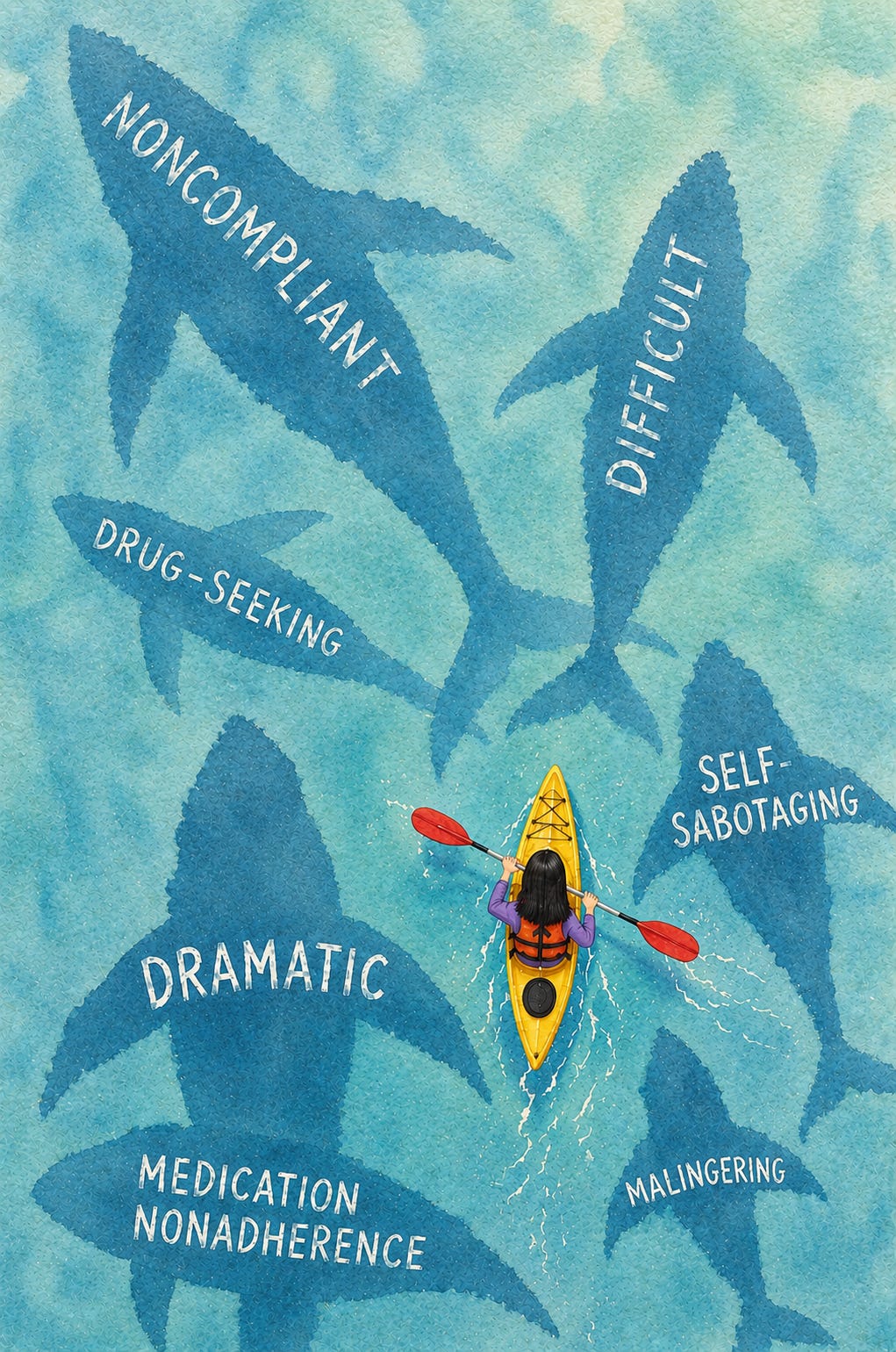
That sounded ridiculous.
How many times had I heard my own patients say they lost their medication, or their pets ate it, and nodded politely while secretly wondering if they were drug-seeking?
Too many.
The medication I accidentally turned into porridge was just thyroid hormone. Still, I didn’t want my doctor to think I was making up excuses to cover for…what exactly? Taking extra pills to lose weight? Selling them on the street?
So, I rehearsed alternate versions of the story.
I left the bag in the sun and the pills melted.
The bottle spilled into the toilet.
I forgot it at a hotel while traveling.
Each version sounded more “believable” than the last. Yet each drifted further from the truth.
Then I caught myself. Wait a minute. Why do I feel the need to lie just to ask for an early refill?
What was so unbelievable about the truth? It’s not like I accidentally seasoned my stir-fry with Synthroid and ate the whole bottle for dinner.
Yum.
The Routine Suspicion
A few years ago, I asked the #AskThePatient community social media if they had ever lost their medicine before.
Over 500 people replied, 76% said they had.
But more striking than how common it was to lose medication was how many people described being terrified to tell their healthcare providers afterward. For many, that fear was powerful enough that they simply went without important medications rather than ask for an early refill.
And the reasons people lost medications were rarely dramatic:
Bottles spilled. Glass containers broke. Pets ate pills. Medications were stolen. For unhoused patients, having medications lost or taken is often the norm.
Yet healthcare providers often treat these stories with suspicion. In fact, not taking medication exactly as prescribed is one of the fastest ways to earn patients the label: noncompliant.
Studies show medication nonadherence is extraordinarily common, usually for understandable reasons:
Fear of side effects. Cost. Distrust after prior bad experiences. Conflicting medical advice. Complicated regimens. Simple confusion.
One patient in the #AskThePatient community wrote:
“I was labeled noncompliant for refusing NSAIDs even though I had stage 4 kidney disease and my nephrologist told me never to take them.”
Another wrote:
“My cancer medication made me short of breath. The ER doctor told me to stop taking it. Then my oncologist called me noncompliant.”
In other words, what medicine often interprets as defiance is frequently adaptation, self-protection, or survival.
But once patients realize that honesty may earn them shame, dismissal, or suspicion, many begin managing not only their symptoms,
but also how much of themselves they can safely reveal.
The Lying Patients
Among the 1,600 people who responded to another #AskThePatient poll, 66% said they had been accused of lying by healthcare professionals.
Interestingly, 60–80% patients in research studies do admit to withholding or altering information from their doctors. Some pretend to agree with medical advice. Others say they understand instructions when they do not. Many minimize behaviors they expect will invite judgment. And all do this to avoid embarrassment or moral condemnation.
In other words, patients lie to escape the label factory: noncompliant, difficult, drug-seeking, dramatic, self-sabotaging, you name it.
We talk about lying patients as though dishonesty is an intrinsic character flaw. But often, lying is an adaptation to power. People become evasive when honesty carries judgement.
Or worse, punishment.
This is the full circle of medical gaslighting:
By labeling patients as liars, we help create the conditions that make honesty feel unsafe. By dismissing people’s concerns, we teach them to rehearse credibility instead of simply telling the truth.
And somewhere in that process, we lose patients as help-seekers,
and ourselves as help-providers.
The Clinical Facts
I honestly can’t remember which version of the story I ended up using after the apparently hypothyroid Pacific Ocean turned my medication into soup. Chances are, because I exist on the privileged side of the credibility gap, getting an early refill was not hard.
But that couldn’t necessarily be said for someone like Fin.
“Oh,” I answered, “I actually think it’s totally fine to use the medication once a month.”
He looked genuinely startled. “Really?”
“Yeah,” I said casually. “Why not? It’s clearly working for you.”
I pointed toward his skin, which was dramatically better than before we started treatment. He looked down at his hands, once covered in cracks and scratch marks, and laughed softly.
“Yeah,” he admitted. “It really has been working.”
Fin’s skin was objectively better. Yet he still thought he had done something wrong simply because he had not followed my prescription.
Fear of being judged by doctors can become so overpowering that it makes patients distrust even their own lived experience, which, let’s not forget, are clinical facts.
If something is clearly working for a patient, why does it matter so much that it happened slightly outside our instructions? So long as no harm is being done (overdosing, dangerous interactions, cultivation of resistance), why can’t people direct the care happening to their own bodies?
After all, the so-called “standard of care” is often either a statistical average or a long-standing tradition. And averages, by definition, imply variation. Some people need more. Some need less. That’s how averages work.
And if something is merely tradition, then perhaps it’s time to break the tradition of treating prescriptions like orders and start practicing a medicine rooted in bodily autonomy, instead.
The moment Fin realized there would be no morality lesson from Ms. Zha, the real conversation finally began. We talked about his goals, fears, routines, and priorities.
Heck, we even talked about his cat, who had indeed attempted to eat human medications before.
So, as I wrote in my book Consented, perhaps the real question isn’t why patients lie. Perhaps the real question is: what kind of healers are we if patients must first calculate whether the truth is safe before they can tell it?
For without psychological safety, there is no honest history. And without honesty, there is no good medicine.
It’s time we believe our patients.
The same way we believe water gets things wet.
Pets eat things they shouldn’t.
Pills occasionally dissolve into ocean-flavored porridge.
Human beings do ordinary human things.
Maybe medicine should learn to expect that with the same consistency that gravity expects things to fall.
Ask The Patient
If you choose to share or comment, know this: in this space, stories are held with care.
Have you ever avoided telling a healthcare professional the full truth because you were afraid of being judged, dismissed, labeled, or not believed? What happened?
I want to hear from you. 🩵
Yesterday on Substack Live, anesthesiologist and ethicist Alyssa Burgart, MD, MA and I talked about the labels medicine places on people: difficult, noncompliant, dramatic, drug-seeking, malingering. And how those labels shape the way patients experience care, trust, and even their own bodies. If you missed it, you can watch the conversation here.
And thank you to Lauren, Esq. for this beautiful reflection after the conversation.💜
Many of those conversations became part of the emotional backbone of my book, Consented: A Doctor’s Call to End Medical Violence and Reclaim Patient Autonomy, which explores how medicine mistakes obedience for trust, and paperwork for consent.
I had a doctor prescribe me a medication that I am afraid to take. I'm pretty prone to side effects, and there are some other risks that I am extremely concerned about. Instead of asking questions, she sent me to take an expensive test as a dare to prove her right. I saw the judgment and the annoyance at being a bother to her. Now I am without a primary doctor, and I know I need to find a new one, but I hate this medical system so much. It's so hard to find someone who will actually work with you. Luckily, I have a good OB/GYN who is helping me bridge the gap for now.
My doctor always acted as if I was lying and drug seeking (I’m a professional woman in my 60’s who was caregiver to a husband with dementia for years). Last year he suddenly showed me respect, and asked me to consider losing weight. I lost 30 pounds without meds over this year and he refused to acknowledge it. I wrote him about that and he didn’t reply. I’m noncompliant because I don’t trust him. I can’t bring myself to trust people who don’t trust me.