


I’ve always thought there is something inhumane about yanking someone out of deep sleep and making them work.
Unfortunately, that is part of being a country doctor. Every few nights, the phone would ring in the dark.
“Hi, Dr. Zha,” the charge nurse said. “Old man with dementia needs admission for rhabdo.”
Rhabdomyolysis, muscle breakdown caused by prolonged pressure on the body. In elderly patients, it often means the same thing: they fell and couldn’t get up, probably for days.
There was a sadness to cases like this. It’s the cruel reflection of our society’s mishandling of the aging, the wisest people in our family trees alive,
who would soon join our ancestors and become the ones who protected our paths forward.
The Poor Historian
I rolled halfway out of bed and squinted at the clock: 3:14 a.m.
“Mmk,” I mumbled. “How long was he down?”
“Don’t know. He’s not oriented.”
“Not oriented” is another piece of medical shorthand. It means a person can no longer reliably tell you where they are, what year it is, or sometimes even who they are.
You know, the important stuff.
The threads of reality that allow other people to find you.
An hour later, I found myself in the emergency department standing beside an eighty-five-year-old man named Bob.
“Hi, Bob.” I shouted into Bob’s good ear.
Slowly, he turned his head toward me. Every few degrees seemed to catch before continuing, like a rusted gear trying to move.
“Do – you -- know -- where -- you -- are?”
Bob’s face shifted into something resembling a smile.
“No,” he said. Then he paused.
“But I know the white rectangle.”
I looked at the nurse. The nurse looked at me.
“Very poor historian,” she said sympathetically while adjusting his IV.
Good luck with that, her voice seemed to say.
All The History We Needed
On paper, Bob’s problem list included hearing loss and dementia. But that wasn’t really his problem.
Bob lived alone in a trailer outside town. It was unclear whether he’d never had children or simply lost touch with them. His emergency contact was listed as a friend.
Three times a week, a caregiver came for a few hours to help him bathe, organize medications, and prepare food. The rest of the time, he was alone. With a bad hip and brittle bones, Bob was one fall out of bed in his narrow and clustered trailer away from…well, ending up in the hospital.
“Did you fall?” I shouted into his good ear.
No answer.
“How long were you on the ground?”
Nothing.
His labs suggested he’d been there at least half a day. Maybe longer. Eventually I pieced together the story from the chart: his caregiver had arrived for her shift and found him wedged between the toilet and bathtub in his small bathroom, unable to get up or call for help.
She called 911. Now he was here.
Bob closed his eyes. I took that as a sign the interview was over. So, I turned my attention to the things doctors are trained to notice.
I took mental notes his very dark and slightly orange-colored urine in the catheter bag, likely from severe dehydration. The skin on his forearm took almost five seconds to bounce back after I gently pinched it – another sign of severe dehydration. The monitor above his head showed his vital signs – heart rate was slightly high, and blood pressure was slightly low…
That was when I noticed that Bob was still smiling.
Was his smile sightly bigger than a minute ago? Did this mean something? Was there more history to be gathered, or was Bob’s face stuck in a facial expression like how his body was stuck between two objects? I couldn’t be sure.
I looked at my watch, almost 4:00 am. I still had admission orders to write and a full clinic waiting for me in a few hours. I stood up to leave.
Then I heard a whisper.
“I beat ya.”
I turned around. “What did you say, Bob?”
His eyes remained fixed on the ceiling. Yup, his smile widened for sure. He had indeed been in the middle of a grin.
Then he spoke:
You ask me if I fell and for how long I was on the ground.
It’s just a curiosity for you
but it was a choice for me.
Is this when I die
or should I try to stay alive?
I was stunned. My heart started racing and my own eyes widened. I walked back to the stool next to Bob’s ER bed and sat back down.
Bob continued his recital:
I counted seconds, hours, and days
for my helper to come.
At 3 am
I looked up at the ceiling
and saw a white rectangle.
At 8 am
my helper finally came
and found me frozen.
Then somebody who looked like you unfroze me
and saved my life.
Bob turned his head slowly toward me. The movement seemed easier now, as if something that had been locked in place was loosening. Then he lifted his thin left hand and pointed upward.
When I finally opened my eyes
I saw the white rectangle again.
So I said to it
Ha!
I beat ya!
I didn’t die.
The White Rectangle
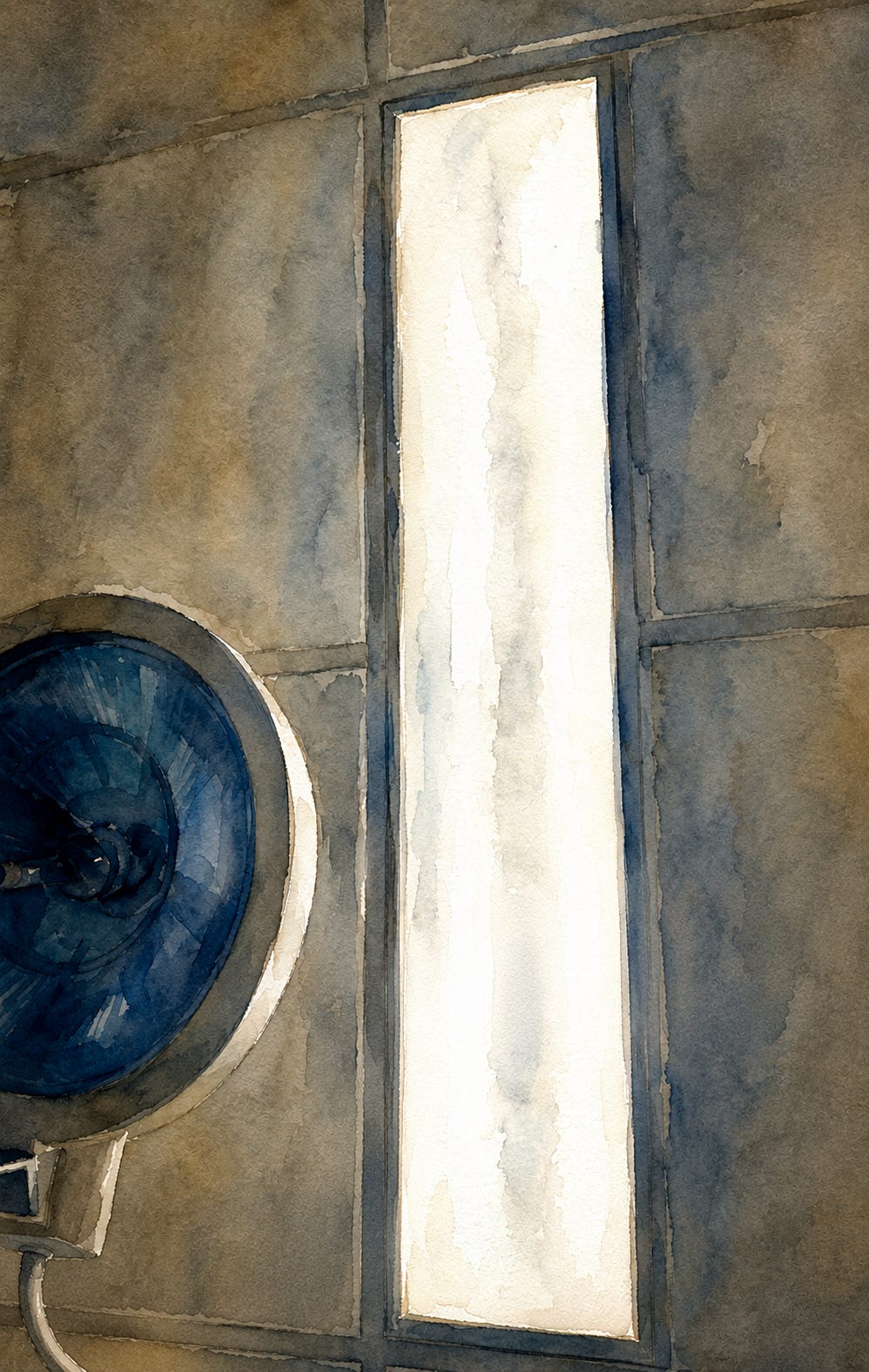
I followed Bob’s finger and looked up. Above us was a fluorescent ceiling light.
A white rectangle.
It was the boring, cold, and ordinary light of a boring, cold, and ordinary hospital ceiling.
The same one he probably had in the narrow bathroom of his trailer.
The same one that watched him count the hours then decide whether to keep living.
The same one that greeted him again when he opened his eyes in an ambulance.
Something that was always just there, emitting just enough light to illuminate but not blind, casting a cone of hope that lasted just long enough for a lonely, aging man to hold onto.
It was nothing beautiful. But it stayed with him.
For those eight hours, the white rectangle became the most patient, considerate, and comforting companion in the universe.
After Bob fell asleep, I snapped a photo of the white rectangle.
Years later today, it still serves as a reminder to always listen just a little longer.
Here is a watercolor rendering of it:
The Poor History Takers
I realized, in his seemingly delirious words, Bob had given us all the history we needed.
Bob was no poor historian. We were poor listeners.
Poorly paying attention.
Poorly waiting for him to answer after firing questions at a newly unfrozen man.
Poorly welcoming a patient back from the edge of surrender,
the edge of death.
We were the poor history takers.
“Thanks for the information, Bob,” I said, squeezing his arm and speaking into his good ear. “This was very helpful. Now get some rest.”
I stood to leave the room. Out of habit, I reached for the switch to dim the light. Then I saw Bob’s lingering smile as he drifted into sleep.
Perhaps there is something inhumane about yanking someone out of a deeply freeze and making them fit our definition of orientation.
Perhaps there is something inhumane about yanking someone out of the deepest freeze of their life and demanding that they immediately fit our definition of orientation.
Tell me the location. Tell me the year. Tell me who you are.
When all along, Bob had been giving us all the answers:
Flat on a bathroom floor. Hour after hour, I chose to stay alive. I’m Bob, saved by the white rectangle.
I took my hand away from the switch.
And left the light on.
Ask The Patient
If you choose to share or comment, know this: in this space, stories are held with care.
Have you ever tried to explain something important to a healthcare professional and felt like they weren’t really hearing what you were trying to say? What did you wish they had understood?
I want to hear from you. 🩵
If Bob’s poetic recounting speaks to you, my book Consented: A Doctor’s Call to End Medical Violence and Reclaim Patient Autonomy explores what it says deeper.
Medicine has many definitions for “normal:” oriented, reliable, compliant, good historian. In Consented, I examine what happens when patients fall outside those definitions and are labeled difficult, noncompliant, dramatic, or confused, simply because their stories don't follow the script medicine expects.
Today at 1 PM PT / 4 PM ET, I’ll be joining pastor and author MaryAnn McKibben Dana for a conversation about Consented, which shares a book birthday with her newest release, Better Than Normal: Virtues for an Off-Script Life. Together, we'll explore what happens when our lives and stories fail to follow the scripts handed to us.
As illuminated to us by the white rectangle, perhaps the script is too small. I hope you’ll join us live.
I love finding one of your essays in my email. This is a fascinating look at what it means to be oriented. Clearly he was oriented to the place he was. I love the way you are reframing medical care.
Taking the time for your patients is a rare event in medicine. What a lovely story. I’ve read your book and encourage people to read it. It’s so clarifying and true and it shows how systems and people interact for good or ill. It’s a road to follow.